Friday 30 March 2007

Timbuktu to Gao


56km East of Timbuktu, our clutch burned out. We were not even on a track, but travelling cross-country from the bank of the river Niger to the main piste, some 10km to the north. We were slightly lost and came upon some woven reed huts, and a man in deep blue robes was kindly walking ahead to show us the route to the main track when we came to a sudden halt with the unmistakable smell of burnt clutch plate. We were in a hollow, amid thick spiny scrub on low dunes. Happily we had other company also, as we had met Christophe and Judith in Timbuktu. They are travelling from Germany to South Africa in their Land Rover Defender, and we had decided to travel to Gao together, just in case of an event such as this. 

We tried towing, but the sand was too deep and the car too heavy. The sun was low, so we made a quick decision to take our coordinates, grab our bags and return to Timbuktu in the Germans’ vehicle, about one and a half hours away on a rough sandy piste. The man in blue kindly offered his services as guardian of the car, and settled down under a thorn tree. 

The day’s excitement was not yet over. On the way back, Christophe hit a sand trap, and, just as we did two days ago, landed on his steering rod and bent it. He is a mechanic and was completely unfazed – in ten minutes flat the bar was off, straightened roughly, and back on.
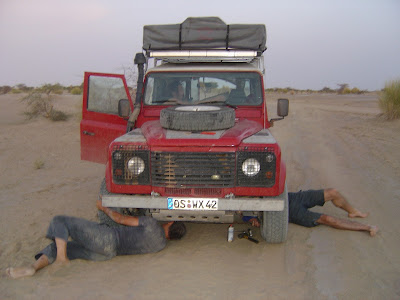
Another picture of people under a car (Christophe and Con in this case) 

We returned to our friendly mechanics in the outskirts of Timbuktu. The chief was all set to leave immediately for the bush to remove the clutch, but we said it could wait til the morning. We gave him a description of the part, and he promised to track one down. Indeed, by 9.30 the next morning he was at the hotel, used clutch plate in hand – not exactly pristine, but serviceable. After a few hours of mysterious delay, our enlarged expedition set off. We had a driver, four mechanics, Judith and Christophe (who kindly stayed with us, delaying their own progress) in their own car, and two GPSs, without which we would never have found the car again.


On the way, the mechanics’ car broke a back leaf spring, and they fixed it with a bit of wood cut from a small tree, and plenty of wet rope. Their bush mechanic skills are incredible. For replacing a clutch, the Haynes Manual says: Remove the transmission, or the engine. If no other work is to be carried out on the transmission, it is far simpler to remove the engine... Locating a suitable place to work is extremely important. If a garage is not available, at the very least a flat, level, clean work surface is required.

"Clutch Camp"


Needless to say, Timbuktu mechanics do not need a Haynes manual. In just two hours - in the sand, in the heat, in the middle of nowhere - they removed the exhaust and transmission and found that the spare part would indeed fit. Sadly, the other part of the plate was worn and cracked and would also need replacing. So, they left their tools and set off again for Timbuktu, while we made camp and cooked - red curry, with polish sausage, imported by Con.

Christophe and Judith enjoying the delay

At 7.30am, the mechanics were back with the part, and I have no idea how they found us without a GPS. By 10.00am, the car was back together and we were ready to continue our journey, a bit poorer but with gratitude and admiration for their quick and expert work. 

Despite our remote location, it was amazing how many people dropped by to visit. On foot, camel and horseback, we had a series of visitors, many with headaches and other ailments. We dispensed paracetamol, which is at the limit of our medical competence.

On the bank of the Niger with Christophe, Judith and local residents


Back on track, lunch stop

Timbuktu, Mali

Although the approach to Timbuktu is tarred, the streets are of sand, often deep. We settled in at the Hotel Colombe, which has a roof terrace that is fine for observing the coming and going on the main street. Most traffic is donkey powered. The breakfast bread is baked in an oven in the street, and is gritty. Dinner is beef, mutton or chicken with potatoes, rice or couscous. The bottles of Castel are ice cold.


We had a half-hearted look at some houses of European explorers, and the attractive mud mosques. The majority of time outside of the hotel is spent in involuntary discussion with souvenir vendors, camel owners, prospective guides, people wanting to buy the car (tempting), and once, a gentleman who said I was in need of a haircut (true) and offered to come to the hotel with his shears. Con invested in a full Tuareg wardrobe.


Friday 23 March 2007

Faces of Mali


Limping into Timbuktu


The piste runs directly north of Douentza to Timbuktu, 200km away. It weaves through an undulating Sahel landscape of acacia bushland, sand and close cropped grasslands. The surface has heavy corrugations, an effect created by the passing of vehicles over time. These literally shake a car to bits, and the wayside is littered with parts of exhausts. It is possible to get relief from the corrugations by driving on parallel sandy tracks, but these are also wearing, as you must keep up momentum to avoid getting stuck, and will inevitably hit a large hole and decide to try the main track again.


So, the car was getting a pounding - by half way it was spraying grease from a leaky hub seal on the right, matched by hydraulic fluid from a broken shock absorber on the left. The corrugations are much less noticeable if you can keep up speed, about 80kph, as you then skim the tops, but it takes full concentration to scan the road ahead to plan the route and also to avoid the holes.


About 10km before the river crossing for Timbuktu we hit a big one, the hard surface suddenly gave way to a deep pit of soft sand. The car landed heavily on the front end. We managed to drive out of it, but everything was not well, the front wheels pointing in different directions - the steering push rod was badly bent. We spent an hour trying to straighten it using the bottle jack.

The Sand Trap That Did The Damage

Ferry across the Niger approaching Timbuktu

It was lucky we were not far from Timbuktu. We drove slowly on to the river crossing, having lunch by the bank as we waited for the ferry. We reversed up the ramp, followed by a horseman with a decorated saddle, bare feet in round metal stirrups.

There was only another 10km then to Timbuktu, and we limped in with great grinding and squeaking. We checked in at a hotel and gave them a pile of very dirty clothes and towels, showered, and went in search of repairs. The hotel called a mechanic, and he sat in and showed us the way through the maze of sandy streets. Along the way, the police gave us a hard time about having three people in two seats, which is a bit of a joke considering how they fill vehicles here. They also insisted we should visit the Customs for a laissez passer document, and register with the police, both of which I expect will be opportunities to make donations to local funds.

On the outskirts of town we parked under a tree amid a collection of vehicle wrecks, mechanics, apprentices, consultants and onlookers. With a handful of tools, they set to work, removing the steering rod and dispatching it to the forge for straightening. A couple of hours later, the car was driving better than ever.


Hitchhikers

Mali is one of the poorest countries in the world, but fuel prices are not much different to Ireland - 82c per litre for diesel and almost €1 for petrol. I expect this is because of the cost of trucking it in on poor roads from the Atlantic coast in Ivory Coast or Senegal. There is little motor traffic - government or NGO Toyota Land Cruisers; some heavily laden trucks, often broken down; and a variety of decrepit buses. It is much more common to see people walking, in donkey carts, or - especially here in the North - on camel or horseback. 


We pick people up whenever feasible. One fine gentleman sat into the car and announced that he was Baobucar Cisské, the Grand Marabout and Grand Imam of Hamdallaye, a historic town north of Djenne. The next day, we stopped in the middle of nowhere for a young man who spoke surprisingly good English. He was a Nigerian footballer who had come to play in Mopti, but for some reason the job had fallen through, and now he was penniless and walking to Bamako. It was about 45˚C and he'd covered over 40 miles from Mopti since the previous day. He promised to remember us when he is playing for Chelsea. 

The group in the photo were near the Dogon village of Yenndouma, returning from market with a heavy sack.


Djenne and back to Pays Dogon


Con arrived on Monday, which is market day in Djenne, so we decided it would be worth a detour to the famous town. We took a ferry across the Bani river, which is very low at this time of year, and drove along a causeway - in wet season the town is almost surrounded by water. We crawled through the busy streets to the main square and parked under the wall of the great mosque, the largest mud building in the world. The market is wonderfully chaotic, and ideal for short people, as the awnings are all tied about four feet from the ground. We bought potatoes, onions, lemons, bananas, ginger and tomatoes, and Con got a little carved Dogon granary door. 


The dust was choking, and after exploring a little we retreated to the courtyard of Chez Baba, a hotel near the square, for a beer (the inferior Flag instead of Castel). The sun did not set, but faded into the dust haze, as trucks were packed with goods and people. When the crowd had dispersed we moved the car to the hotel, and slept on the roof, with a fine view of the mosque and only a few mosquitoes. 


From Djenne we drove into Dogon country again, taking the same route though Sanga that Stefanie and I followed last week. We camped under the ancient rocks of the escarpment, so peaceful that I could hear the sound of bat wings in the night. In the morning we spent a couple of hours fixing stuff in the car, visited by a group of small boys. They almost fought over who would do the breakfast dish washing, and in the end one passed the dirty items, one washed, one dried and one stacked the clean items. They gave the stove a good cleaning too, and ate our left over pasta. 


A few miles on, we explored one of the villages, invited by a resident. He led us up a boulder track to the old village, now mostly abandoned. It has water, but the effort of carrying goods up and down has resulted in most people moving to the new village below. Only his family remain, and his wife was at work pounding couscous in their courtyard. He was very proud of his little terraces of crops, including onions, tobacco, papaya and banana, irrigated from the spring by hand using calabashes.


Monday 19 March 2007

Photos from the road, Mali


I have picked Con up now, and we are off to Timbuktu. I expect we will not have internet access for a week or so, until we reach Niamey in Niger.

This blog is the diary of a journey through the Sahara undertaken February-May 2007. The most recent post is first.