Saturday 21 April 2007

Photos - Tamanrasset to Djanet

We are now in Ghardaia, a city made up of five old fortified towns. It is really beautiful, so we have decided to stay a second night. These are some photos of the journey from Tamanrasset to Djanet.


Travel companions - Claire and Leon from Netherlands in a Series III, and Haakon from Norway on his bike. The Dutch carried our guide, and Claire spent a lot of time on the roof

The roof was a a popular place to sit - good view, good breeze and no danger of this old Land Rover going too fast, especially on lava boulder terrain.


We crossed great gravel plains known as regs, and any feature, such as these boulders, stood out for miles. 


There wasn't too much sand - our guide knows the desert well and was very good at picking routes that avoided tricky sections.

 Not many trees either, so we were happy to use this one for a lunch stop.


Leon - generally he spends more time under the Land Rover than on top

For the first day we travelled through volcanic hills, like this one where we camped. It had to be climbed, and of course turned out to be a lot higher than it looked - we earned that Amsterdam beer. The hills have basalt columns like the Giants Causeway in Antrim, and they have crumbled to form boulder slopes.


Our camp (above) viewed from the mountain top (below)


Morning coffee

Back on the tar road, and a long way from Algiers


Thursday 19 April 2007

A Note from Algeria

Today we reached In-Salah in southern Algeria. We spent the last ten days crossing to Djanat near Libya and back via the Tefedest mountains. Great trip. Will post some photos when we reach Tunisia in a few days.

Tuesday 10 April 2007

Wrecks of the Hoggar

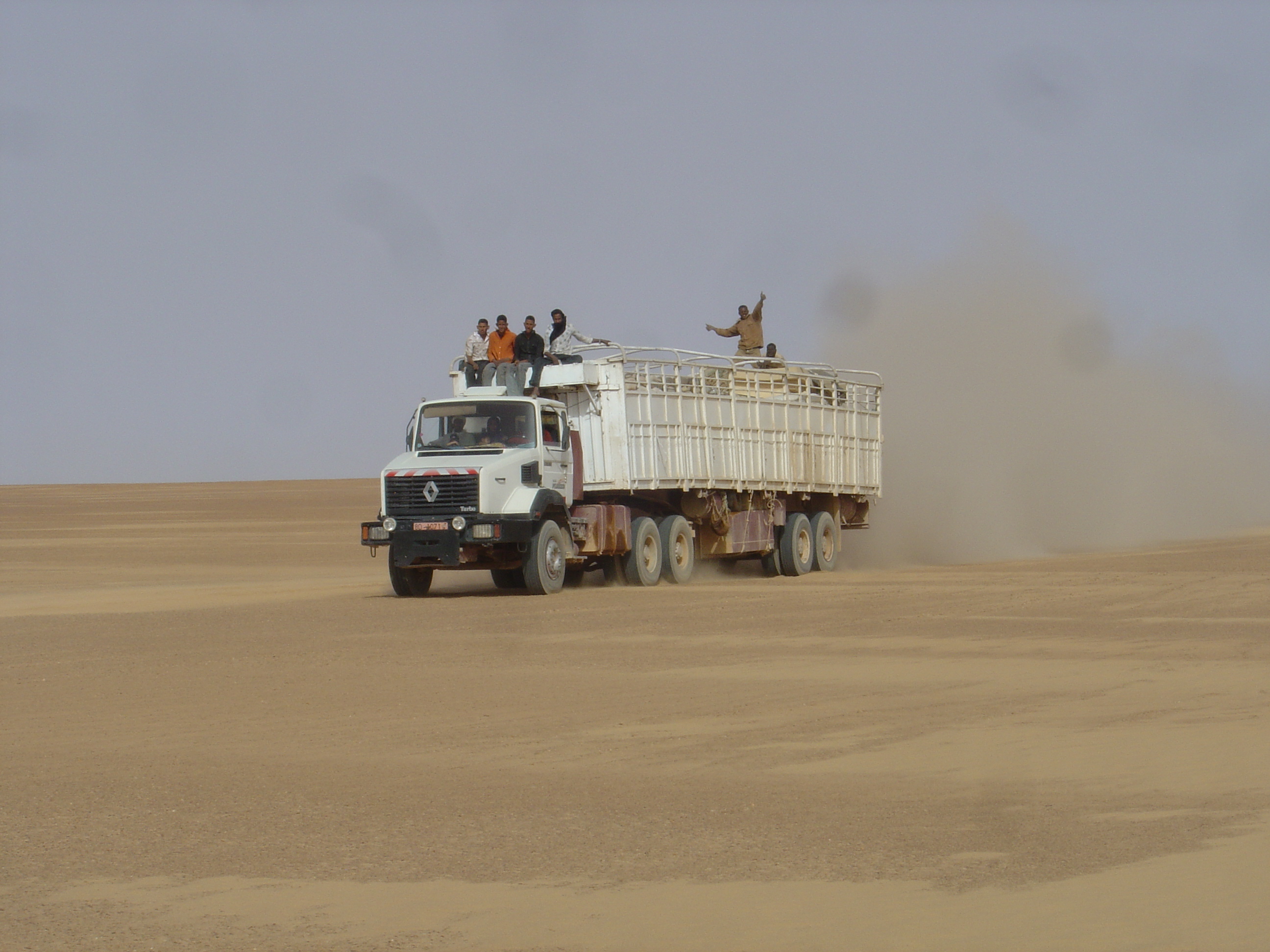
The Hoggar Route crosses the Sahara. It is the classic central trans-Sahara route, and one of the very few passable in a non-4x4 vehicle. However, not all make it. There are some very sandy sections, especially on the Niger side between Agadez and the border. Dozens of vehicle carcasses litter the route, their paint sand-blasted.


Monday 9 April 2007

Diesel and Dust, the road to Tamanrasset


The Algerian border post - we camped on their football pitch

Lots of this en route


Con and Haakon are wondering how this chap was changing an axle, solo, in the middle of nowhere; so far for five days

The first part of the road from the border town to Tamanrasset has nice tar

Later it doesn't

We have arrived in Tamanrasset, Algeria and it is a wonderful place. 35°C seems crisp and cool after the heat of Agadez and it has a Mediterranean feel despite being in the heart of the Sahara: pavement cafés under trees, good coffee again. It is also relaxing to have no hassles at all on the streets, no hawkers, no cadeaux cadeaux. Even the sky is clear of dust. 

I have already written too much car stuff, but it is hard to avoid. All I can say is that the roads, heat and dust are tough on all vehicles, and everyone has problems. The piste from Agadez to Tamanrasset is littered with the remains of hundreds of vehicles that never made it. So, the short version is as follows. 25km out of Agadez we had a big deja vu of Timbuktu - clutch went, the hydraulics (again) this time.


Back to Agadez, where after a day of work they found that the push rod was broken, a fault on all Discoverys and Range Rovers. They sourced a part, fixed it and we were off, two days late. Our Algeria guide had been waiting for us at the border, a lonely walled compound in the desert, and we met on the evening of the 6th April. The border was fine, the officials very friendly. 

The piste north is beautiful, with volcanic hills, rubble piles, some deep sand, some long fast stretches of harder sand. The piste braids often and the faster guide car (Toyota HJ80) and Haakon's bike went ahead and we travelled with the Dutch LR Series III. At one point we saw that they had taken a parallel piste in the distance and cut across to catch them (Con was with Leon, reclining in comfort, Claire with me). Just as we reached their piste my drive belt disintegrated in spectacular fashion. The guide car and Haakon arrived soon after, and though we had the spare belt on quickly, it was several hours before we caught up with Leon and Con - despite having the slowest vehicle, they made steady progress. 

The border had no fuel, so we were all low on diesel. Haakon had got petrol with special permit from the police. We managed to get 20 litres from a drilling work site. So there was a lot of jerry can work today, and we arrived coated in diesel and dust. A pleasant camp in the east of the town, where we met Yves and Mohammed of Tanezrouft Voyages, our agency. They have just returned from a short trip to Mali. Over dinner of camel brochettes they devised a two-week route for us that will take us East to Djanet, back to In Salah via the Tefedest mountains and to Tunisia.

Tuesday 3 April 2007

Grande Fantasia for the Colonel

In Tahoua we stocked up the beer supply – whatever about fuel and water, it would be a disaster to run out over the coming weeks in the desert. This is not so simple, as it is hard to find – although bottles and cans are brewed locally, it is a luxury most people cannot afford. We started in the market, changing money with a clothes seller. Surprisingly, he pulled out two electronic counterfeit detectors from under the piles of cloth. The rate is the same as the bank, but it is quicker and avoids commission. They prefer big notes, sneering at 10s and 20s. 

The lad then hopped in the car and brought us to three different places in search of the beer. We found it at a private house near a rubbish-filled gully, buying a couple of cases of Amsterdam from the lady of the house.


The next 400km to Agadez saw a shift from Sahel to desert again. Where there was water there were people, green crops and animals. But as we drove, the trees thinned to bushes, and villages were fewer. The attractive rounded huts of mud and straw, shaded by old trees, were replaced by squat buildings with flat roofs, cracked walls exposed to sand laden gusts of wind. The road tar is pock-marked by some nasty potholes, and near villages the local boys had made amateur repairs, and made great show of throwing earth as we approached, in hope of a coin or two. 

100km before Agadez there was hardly a tree to be seen and we returned to piste - the road is under construction but no activity was to be seen. Like Timbuktu, the town arrives suddenly - a water tower on the horizon, then the tall mud minaret of the Grande Mosque. The bored police at the checkpoint had a long chat and confirmed that Gaddafy was still in town for the festival of the Prophet’s Birthday. He was in residence in a large white marquee on the approach to town. Not surprisingly, we had trouble finding a room, as the town is teeming with officials, drivers, police and military. 


We finally found a dark room at the Hotel Agriboun, where the ceiling fan did its best to move the hot air. Streams of people and Toyotas were going to the North – a grande fantasia was to take place in honour of the Colonel. Every 100 metres a soldier stood guard. On the outskirts of town there was an amazing sight - thousands of camel-borne Tuareg and Fula lined up in full ceremonial style surrounded a crowd that represented every tribe in the country, also in their best. The camels stand very patiently flank to flank, not bothered by the size of the crowd. A line of tall young Wodaabé men stood in front of the camels, their faces painted. They are famous for the annual Cure Salée festival, where their make-up and dancing are used to attract a bride. I got the impression they had already being waiting for hours, and after a few requests my water was gone.


In front again were clusters of musicians, dancers and singers, all waiting for the two Presidents to arrive. A stage had been built and furnished with two large cream armchairs. As we waited, a tanker watered the sand of the performance area, and the police made an effort at crowd control. This was generally good-natured. A group – especially the Toureg women – would decide they did not like their vantage point, and they would get up en masse and move. As the army rallied and tried to muster them, another part of the crowd would flow around them. The officers would shout at each other and shrug. But as the time got closer, patience wore and some of the police waved clubs and took to shins with branches. Closer to the stage was patrolled by Libyan officials in khaki, and when the dignitaries arrived they were almost invisible behind another layer of security – although sad to say I could not see any of Gaddafy’s legendary team of female bodyguards. The man himself was just about discernible, dressed in blue robes, as he accepted gifts, including a fine white camel. Then the thousands of camelmen paraded past the stage, to the sounds of women singing and ululating. Fireworks finished the event, as the cavalcade departed in a cloud of dust, and later I heard jets taking off.


The nights in Agadez are oppressive, the houses are ovens, and people move outside to sleep. After one night in the hotel we moved to the house of a Frenchman who has kindly offered to allow us to stay, even though he has departed for France to escape the coming hottest months of the year. His cook is looking after us.

Also guests are a Dutch couple, Leon and Claire, with an ancient British Army Land Rover III and a Norwegian, Haakon, with a motorcycle. We will all join forces for the next part of the journey, through Algeria.


Sunday 1 April 2007

Faces of Niger


Northwards Again Through Niger

Since Bamako, we have mainly been following the Niger river in an easterly direction. At Niamey the river flows South for Benin, Nigeria and the Atlantic, and we turned East and then North for the Sahara again. 


Mali had some prior familiarity – the music, Timbuktu, the travels of Mungo Park – but I knew nothing at all of Niger, apart from a famine appeal a couple of years ago. But it looks very interesting, the people are friendly, and I’m sorry we don’t have more time to explore the country. 

The road to Agadez is tarred most of the way, and passes through many villages. Dust devils, mini tornadoes, sweep across the fields which are stubble at this time of year. Many people have deep facial cuts. I asked a policeman about his four cicatrice – two at each side of his mouth, and he said he was a Maouri, and received the incisions at the time of his birth. When we told him we were going to Agadez he said we would have plenty of security, as President Gaddafy of Libya is visiting the town for the Prophet’s Birthday. 


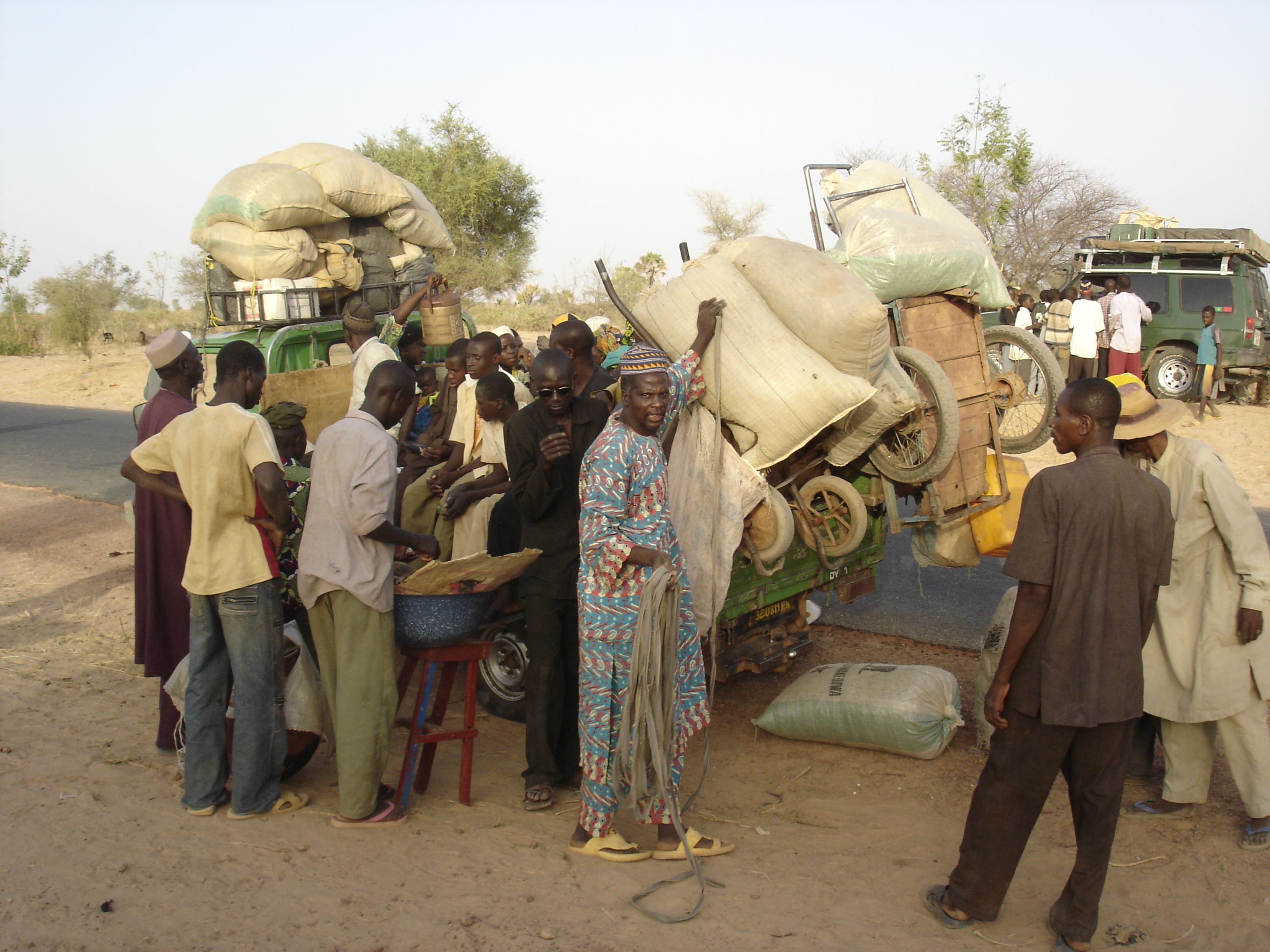
In the mornings and evenings we come across streams of people and animals going to or coming from market. We stopped at a couple, one of them near the town of Dosso. Activity was winding down, trucks and old Land Rovers being packed. But there was still plenty of people of diverse tribes, animals tethered under trees, mutton kebabs cooking over wood fire. I started with a couple of boys trailing me and ended with about fifty, swarming around and trying to jump into photos. 


We camped undisturbed in savannah near the border with Nigeria, and continued to the town of Birniri-Konni. This turned out to be a centre for smuggled fuel from Nigeria. We were tempted to fill up at about 50c/litre, but were worried that it could be adulterated so went to the filling station and paid the usual 80c. We stayed that night in Tahoua, at what is listed as the best hotel in town. It looked basic but had the essentials: clean room and cold beer; plus some extras – air conditioning, and pretty good steak and chips. A cold shower would have been nice but the water comes roasting from the roof tank. And the night guard washed the car.


This blog is the diary of a journey through the Sahara undertaken February-May 2007. The most recent post is first.