Tuesday 3 April 2007

Grande Fantasia for the Colonel

In Tahoua we stocked up the beer supply – whatever about fuel and water, it would be a disaster to run out over the coming weeks in the desert. This is not so simple, as it is hard to find – although bottles and cans are brewed locally, it is a luxury most people cannot afford. We started in the market, changing money with a clothes seller. Surprisingly, he pulled out two electronic counterfeit detectors from under the piles of cloth. The rate is the same as the bank, but it is quicker and avoids commission. They prefer big notes, sneering at 10s and 20s. 

The lad then hopped in the car and brought us to three different places in search of the beer. We found it at a private house near a rubbish-filled gully, buying a couple of cases of Amsterdam from the lady of the house.


The next 400km to Agadez saw a shift from Sahel to desert again. Where there was water there were people, green crops and animals. But as we drove, the trees thinned to bushes, and villages were fewer. The attractive rounded huts of mud and straw, shaded by old trees, were replaced by squat buildings with flat roofs, cracked walls exposed to sand laden gusts of wind. The road tar is pock-marked by some nasty potholes, and near villages the local boys had made amateur repairs, and made great show of throwing earth as we approached, in hope of a coin or two. 

100km before Agadez there was hardly a tree to be seen and we returned to piste - the road is under construction but no activity was to be seen. Like Timbuktu, the town arrives suddenly - a water tower on the horizon, then the tall mud minaret of the Grande Mosque. The bored police at the checkpoint had a long chat and confirmed that Gaddafy was still in town for the festival of the Prophet’s Birthday. He was in residence in a large white marquee on the approach to town. Not surprisingly, we had trouble finding a room, as the town is teeming with officials, drivers, police and military. 


We finally found a dark room at the Hotel Agriboun, where the ceiling fan did its best to move the hot air. Streams of people and Toyotas were going to the North – a grande fantasia was to take place in honour of the Colonel. Every 100 metres a soldier stood guard. On the outskirts of town there was an amazing sight - thousands of camel-borne Tuareg and Fula lined up in full ceremonial style surrounded a crowd that represented every tribe in the country, also in their best. The camels stand very patiently flank to flank, not bothered by the size of the crowd. A line of tall young Wodaabé men stood in front of the camels, their faces painted. They are famous for the annual Cure Salée festival, where their make-up and dancing are used to attract a bride. I got the impression they had already being waiting for hours, and after a few requests my water was gone.


In front again were clusters of musicians, dancers and singers, all waiting for the two Presidents to arrive. A stage had been built and furnished with two large cream armchairs. As we waited, a tanker watered the sand of the performance area, and the police made an effort at crowd control. This was generally good-natured. A group – especially the Toureg women – would decide they did not like their vantage point, and they would get up en masse and move. As the army rallied and tried to muster them, another part of the crowd would flow around them. The officers would shout at each other and shrug. But as the time got closer, patience wore and some of the police waved clubs and took to shins with branches. Closer to the stage was patrolled by Libyan officials in khaki, and when the dignitaries arrived they were almost invisible behind another layer of security – although sad to say I could not see any of Gaddafy’s legendary team of female bodyguards. The man himself was just about discernible, dressed in blue robes, as he accepted gifts, including a fine white camel. Then the thousands of camelmen paraded past the stage, to the sounds of women singing and ululating. Fireworks finished the event, as the cavalcade departed in a cloud of dust, and later I heard jets taking off.


The nights in Agadez are oppressive, the houses are ovens, and people move outside to sleep. After one night in the hotel we moved to the house of a Frenchman who has kindly offered to allow us to stay, even though he has departed for France to escape the coming hottest months of the year. His cook is looking after us.

Also guests are a Dutch couple, Leon and Claire, with an ancient British Army Land Rover III and a Norwegian, Haakon, with a motorcycle. We will all join forces for the next part of the journey, through Algeria.


Sunday 1 April 2007

Faces of Niger


Northwards Again Through Niger

Since Bamako, we have mainly been following the Niger river in an easterly direction. At Niamey the river flows South for Benin, Nigeria and the Atlantic, and we turned East and then North for the Sahara again. 


Mali had some prior familiarity – the music, Timbuktu, the travels of Mungo Park – but I knew nothing at all of Niger, apart from a famine appeal a couple of years ago. But it looks very interesting, the people are friendly, and I’m sorry we don’t have more time to explore the country. 

The road to Agadez is tarred most of the way, and passes through many villages. Dust devils, mini tornadoes, sweep across the fields which are stubble at this time of year. Many people have deep facial cuts. I asked a policeman about his four cicatrice – two at each side of his mouth, and he said he was a Maouri, and received the incisions at the time of his birth. When we told him we were going to Agadez he said we would have plenty of security, as President Gaddafy of Libya is visiting the town for the Prophet’s Birthday. 


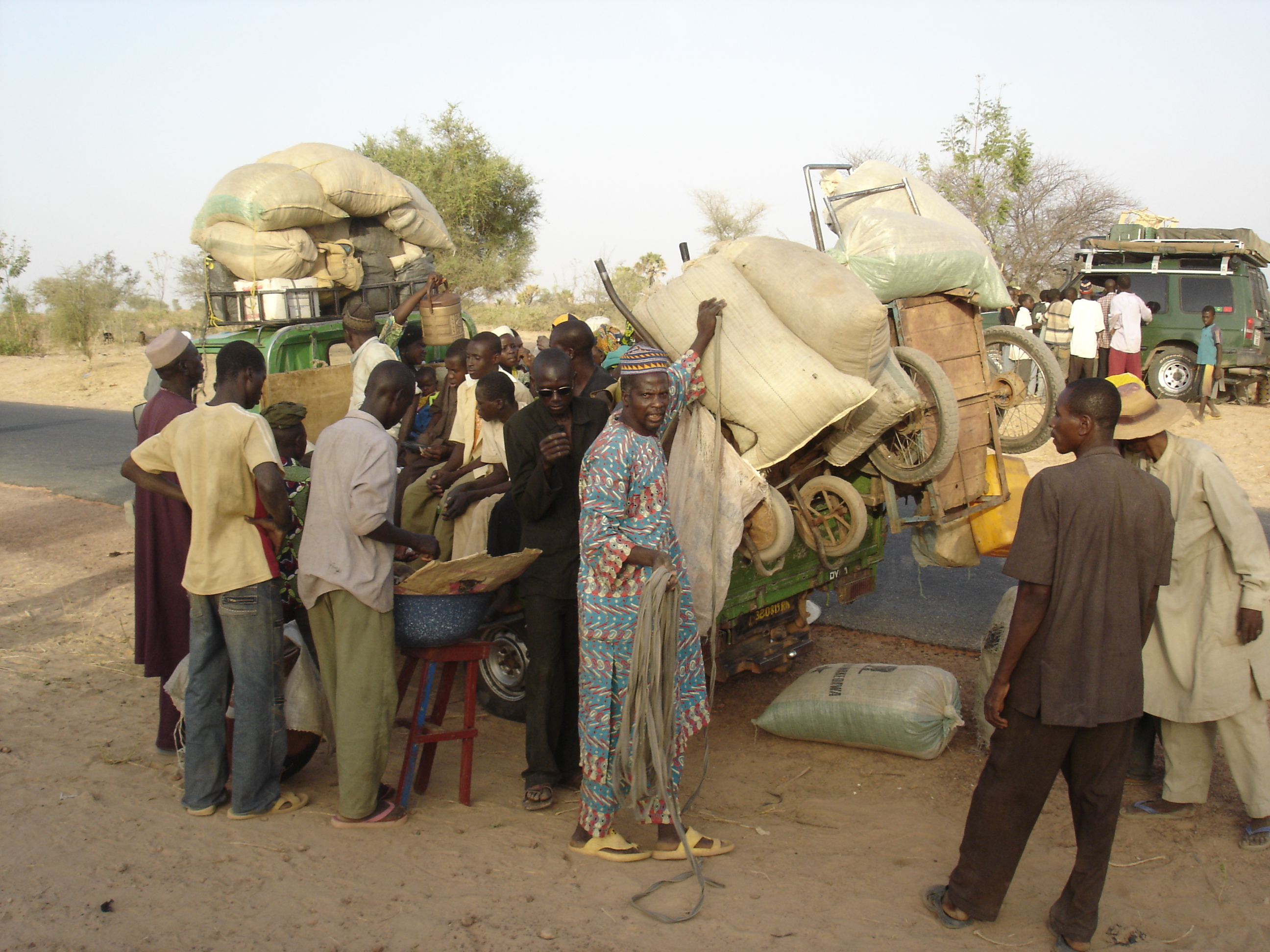
In the mornings and evenings we come across streams of people and animals going to or coming from market. We stopped at a couple, one of them near the town of Dosso. Activity was winding down, trucks and old Land Rovers being packed. But there was still plenty of people of diverse tribes, animals tethered under trees, mutton kebabs cooking over wood fire. I started with a couple of boys trailing me and ended with about fifty, swarming around and trying to jump into photos. 


We camped undisturbed in savannah near the border with Nigeria, and continued to the town of Birniri-Konni. This turned out to be a centre for smuggled fuel from Nigeria. We were tempted to fill up at about 50c/litre, but were worried that it could be adulterated so went to the filling station and paid the usual 80c. We stayed that night in Tahoua, at what is listed as the best hotel in town. It looked basic but had the essentials: clean room and cold beer; plus some extras – air conditioning, and pretty good steak and chips. A cold shower would have been nice but the water comes roasting from the roof tank. And the night guard washed the car.


Friday 30 March 2007

Gao, Mali to Niamey, Niger

After our breakdown adventure near Timbuktu the rest of the journey to Gao was uneventful. It was a beautiful desert drive, sometimes on the banks of the Niger, or in the riverbed itself, as the water is low. There was a lot of sand and gentle dunes, and our ‘new’ clutch gave us a burning smell for the first day as it settled in. The area approaching Bourem was beautiful, with villages between high dunes and the river. It is probably the remotest part of the journey so far, in terms of distance from a tarred road, but we were never long without seeing a mud-walled house or a shepherd resting on a stick. We saw only one vehicle in two days, a truck. We picked up some travellers, Christophe and Judith getting a tax collector in sand-coloured camouflage and armed with AK47, while we got three gents on the roof.


Coming into Bourem we left the river and travelled over a wide empty plain, then an area of sand with many interwoven tracks. We camped among some low dunes a little south of the town.


There are villages every few miles, so we were not surprised to have some visitors for the evening, and morning. In Gao we pulled in at the Sahara Passion hotel for a shower, lunch, and filled our water tanks. They have a nice shady courtyard full of birds, a relief from the heat, which is in the mid 40s. We registered with the police, as advised by the guidebook and hotel staff. The officer offered to stamp us out of Mali to save time at the border - for a fee - but we declined.


The River Niger at Gao

We camped again half way between Gao and the border. It was hard to find a spot remote from the villages that are string along the river. As we cooked dinner, we had two mean arrive separately, one who sat silently and another who chatted. We shared our food, and then when I was on the other side of the vehicle, the friendly one came around and whispered to me that the other man was a bandit, and was going to target us in the night. I said thanks, and we quickly packed up and drove back to the most recent police post. The policeman is exceptionally nice, and told us he does a week’s posting there, night and day, before moving to another town. But there is little traffic, and none at night. In fact the only vehicles we see on the route south are those working on a major upgrade of the road, which will be tarred to the Niger border, and the occasional bus. (This incident was to be the only time I felt at risk during the journey. In the following years, this area became a no-go zone, rife with kidnappings, ambushes and jihadis). 

The border formalities were very smooth on both sides. On the Niger side the officer said "Sinn Fein" when he saw the Irish passports. The granaries are different now, built in large beehive shapes with little straw hats over the openings at the top.


The tarred road reappeared, and we pulled in under a tamarind tree for a salad of potato, tomato and sausage with oil and vinegar dressing.


Niamey is incredibly hot. I left the Rough Guide on the dashboard for half an hour and the glue in the binding melted and the book fell to pieces. (The Bradt Guide to Mali, well stitched, survived). There is not much of interest here to keep us, and we stayed just one night at the Hotel Oasis. I have been in contact with other overlanders that are heading for Algeria, and am keen to catch up with them in Agadez.

Timbuktu to Gao


56km East of Timbuktu, our clutch burned out. We were not even on a track, but travelling cross-country from the bank of the river Niger to the main piste, some 10km to the north. We were slightly lost and came upon some woven reed huts, and a man in deep blue robes was kindly walking ahead to show us the route to the main track when we came to a sudden halt with the unmistakable smell of burnt clutch plate. We were in a hollow, amid thick spiny scrub on low dunes. Happily we had other company also, as we had met Christophe and Judith in Timbuktu. They are travelling from Germany to South Africa in their Land Rover Defender, and we had decided to travel to Gao together, just in case of an event such as this. 

We tried towing, but the sand was too deep and the car too heavy. The sun was low, so we made a quick decision to take our coordinates, grab our bags and return to Timbuktu in the Germans’ vehicle, about one and a half hours away on a rough sandy piste. The man in blue kindly offered his services as guardian of the car, and settled down under a thorn tree. 

The day’s excitement was not yet over. On the way back, Christophe hit a sand trap, and, just as we did two days ago, landed on his steering rod and bent it. He is a mechanic and was completely unfazed – in ten minutes flat the bar was off, straightened roughly, and back on.

Another picture of people under a car (Christophe and Con in this case) 

We returned to our friendly mechanics in the outskirts of Timbuktu. The chief was all set to leave immediately for the bush to remove the clutch, but we said it could wait til the morning. We gave him a description of the part, and he promised to track one down. Indeed, by 9.30 the next morning he was at the hotel, used clutch plate in hand – not exactly pristine, but serviceable. After a few hours of mysterious delay, our enlarged expedition set off. We had a driver, four mechanics, Judith and Christophe (who kindly stayed with us, delaying their own progress) in their own car, and two GPSs, without which we would never have found the car again.


On the way, the mechanics’ car broke a back leaf spring, and they fixed it with a bit of wood cut from a small tree, and plenty of wet rope. Their bush mechanic skills are incredible. For replacing a clutch, the Haynes Manual says: Remove the transmission, or the engine. If no other work is to be carried out on the transmission, it is far simpler to remove the engine... Locating a suitable place to work is extremely important. If a garage is not available, at the very least a flat, level, clean work surface is required.

"Clutch Camp"


Needless to say, Timbuktu mechanics do not need a Haynes manual. In just two hours - in the sand, in the heat, in the middle of nowhere - they removed the exhaust and transmission and found that the spare part would indeed fit. Sadly, the other part of the plate was worn and cracked and would also need replacing. So, they left their tools and set off again for Timbuktu, while we made camp and cooked - red curry, with polish sausage, imported by Con.

Christophe and Judith enjoying the delay

At 7.30am, the mechanics were back with the part, and I have no idea how they found us without a GPS. By 10.00am, the car was back together and we were ready to continue our journey, a bit poorer but with gratitude and admiration for their quick and expert work. 

Despite our remote location, it was amazing how many people dropped by to visit. On foot, camel and horseback, we had a series of visitors, many with headaches and other ailments. We dispensed paracetamol, which is at the limit of our medical competence.

On the bank of the Niger with Christophe, Judith and local residents


Back on track, lunch stop

Timbuktu, Mali

Although the approach to Timbuktu is tarred, the streets are of sand, often deep. We settled in at the Hotel Colombe, which has a roof terrace that is fine for observing the coming and going on the main street. Most traffic is donkey powered. The breakfast bread is baked in an oven in the street, and is gritty. Dinner is beef, mutton or chicken with potatoes, rice or couscous. The bottles of Castel are ice cold.


We had a half-hearted look at some houses of European explorers, and the attractive mud mosques. The majority of time outside of the hotel is spent in involuntary discussion with souvenir vendors, camel owners, prospective guides, people wanting to buy the car (tempting), and once, a gentleman who said I was in need of a haircut (true) and offered to come to the hotel with his shears. Con invested in a full Tuareg wardrobe.


This blog is the diary of a journey through the Sahara undertaken February-May 2007. The most recent post is first.