Thursday 19 April 2007
A Note from Algeria
Tuesday 10 April 2007
Wrecks of the Hoggar


Monday 9 April 2007
Diesel and Dust, the road to Tamanrasset


Lots of this en route
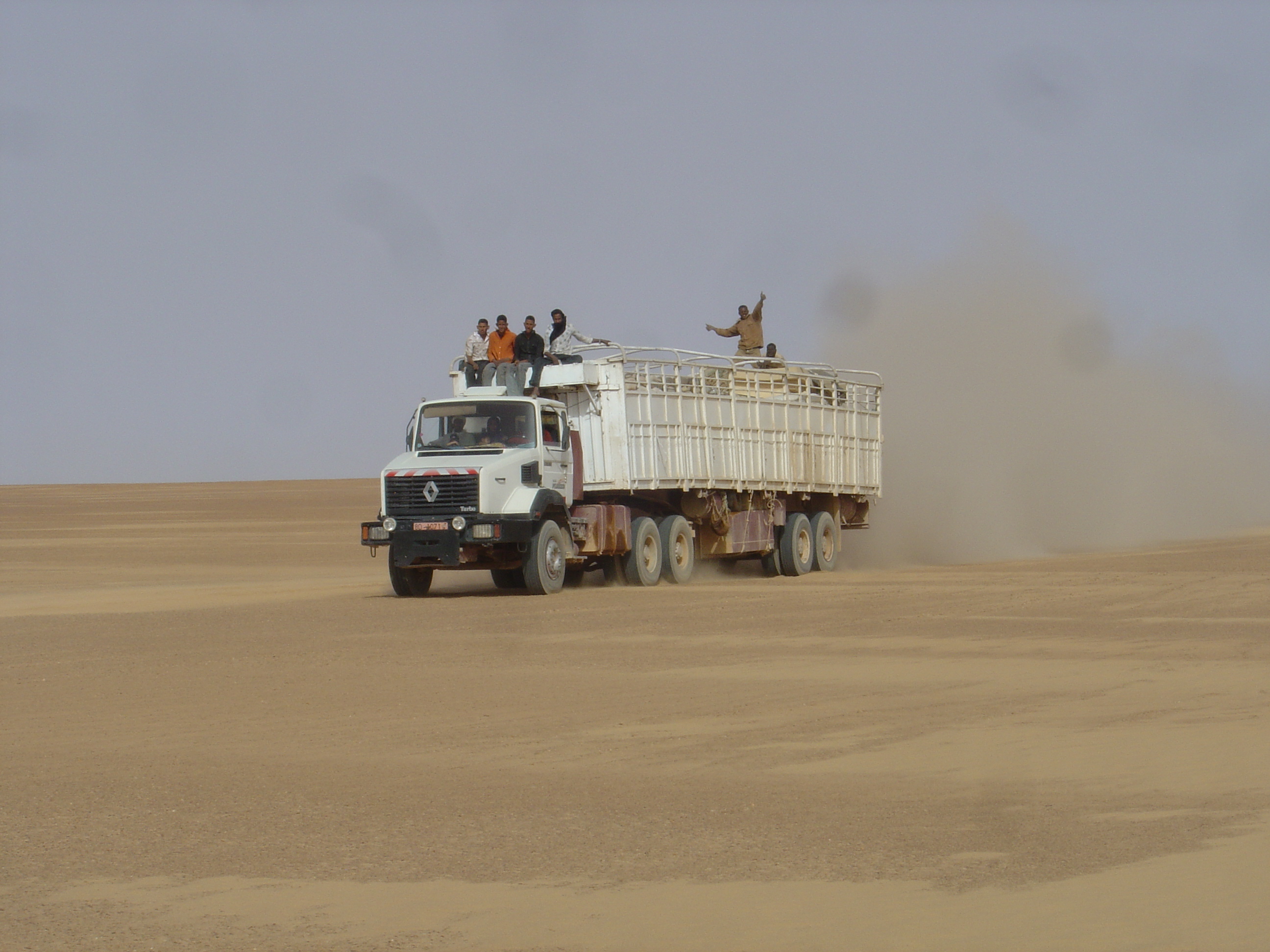


We have arrived in Tamanrasset, Algeria and it is a wonderful place. 35°C seems crisp and cool after the heat of Agadez and it has a Mediterranean feel despite being in the heart of the Sahara: pavement cafés under trees, good coffee again. It is also relaxing to have no hassles at all on the streets, no hawkers, no cadeaux cadeaux. Even the sky is clear of dust.
I have already written too much car stuff, but it is hard to avoid. All I can say is that the roads, heat and dust are tough on all vehicles, and everyone has problems. The piste from Agadez to Tamanrasset is littered with the remains of hundreds of vehicles that never made it. So, the short version is as follows. 25km out of Agadez we had a big deja vu of Timbuktu - clutch went, the hydraulics (again) this time.

Back to Agadez, where after a day of work they found that the push rod was broken, a fault on all Discoverys and Range Rovers. They sourced a part, fixed it and we were off, two days late. Our Algeria guide had been waiting for us at the border, a lonely walled compound in the desert, and we met on the evening of the 6th April. The border was fine, the officials very friendly.
The piste north is beautiful, with volcanic hills, rubble piles, some deep sand, some long fast stretches of harder sand. The piste braids often and the faster guide car (Toyota HJ80) and Haakon's bike went ahead and we travelled with the Dutch LR Series III. At one point we saw that they had taken a parallel piste in the distance and cut across to catch them (Con was with Leon, reclining in comfort, Claire with me). Just as we reached their piste my drive belt disintegrated in spectacular fashion. The guide car and Haakon arrived soon after, and though we had the spare belt on quickly, it was several hours before we caught up with Leon and Con - despite having the slowest vehicle, they made steady progress.
The border had no fuel, so we were all low on diesel. Haakon had got petrol with special permit from the police. We managed to get 20 litres from a drilling work site. So there was a lot of jerry can work today, and we arrived coated in diesel and dust. A pleasant camp in the east of the town, where we met Yves and Mohammed of Tanezrouft Voyages, our agency. They have just returned from a short trip to Mali. Over dinner of camel brochettes they devised a two-week route for us that will take us East to Djanet, back to In Salah via the Tefedest mountains and to Tunisia.
Tuesday 3 April 2007
Grande Fantasia for the Colonel


We finally found a dark room at the Hotel Agriboun, where the ceiling fan did its best to move the hot air. Streams of people and Toyotas were going to the North – a grande fantasia was to take place in honour of the Colonel. Every 100 metres a soldier stood guard. On the outskirts of town there was an amazing sight - thousands of camel-borne Tuareg and Fula lined up in full ceremonial style surrounded a crowd that represented every tribe in the country, also in their best. The camels stand very patiently flank to flank, not bothered by the size of the crowd. A line of tall young Wodaabé men stood in front of the camels, their faces painted. They are famous for the annual Cure Salée festival, where their make-up and dancing are used to attract a bride. I got the impression they had already being waiting for hours, and after a few requests my water was gone.


In front again were clusters of musicians, dancers and singers, all waiting for the two Presidents to arrive. A stage had been built and furnished with two large cream armchairs. As we waited, a tanker watered the sand of the performance area, and the police made an effort at crowd control. This was generally good-natured. A group – especially the Toureg women – would decide they did not like their vantage point, and they would get up en masse and move. As the army rallied and tried to muster them, another part of the crowd would flow around them. The officers would shout at each other and shrug. But as the time got closer, patience wore and some of the police waved clubs and took to shins with branches. Closer to the stage was patrolled by Libyan officials in khaki, and when the dignitaries arrived they were almost invisible behind another layer of security – although sad to say I could not see any of Gaddafy’s legendary team of female bodyguards. The man himself was just about discernible, dressed in blue robes, as he accepted gifts, including a fine white camel. Then the thousands of camelmen paraded past the stage, to the sounds of women singing and ululating. Fireworks finished the event, as the cavalcade departed in a cloud of dust, and later I heard jets taking off.


The nights in Agadez are oppressive, the houses are ovens, and people move outside to sleep. After one night in the hotel we moved to the house of a Frenchman who has kindly offered to allow us to stay, even though he has departed for France to escape the coming hottest months of the year. His cook is looking after us.
Also guests are a Dutch couple, Leon and Claire, with an ancient British Army Land Rover III and a Norwegian, Haakon, with a motorcycle. We will all join forces for the next part of the journey, through Algeria.


Sunday 1 April 2007


Northwards Again Through Niger


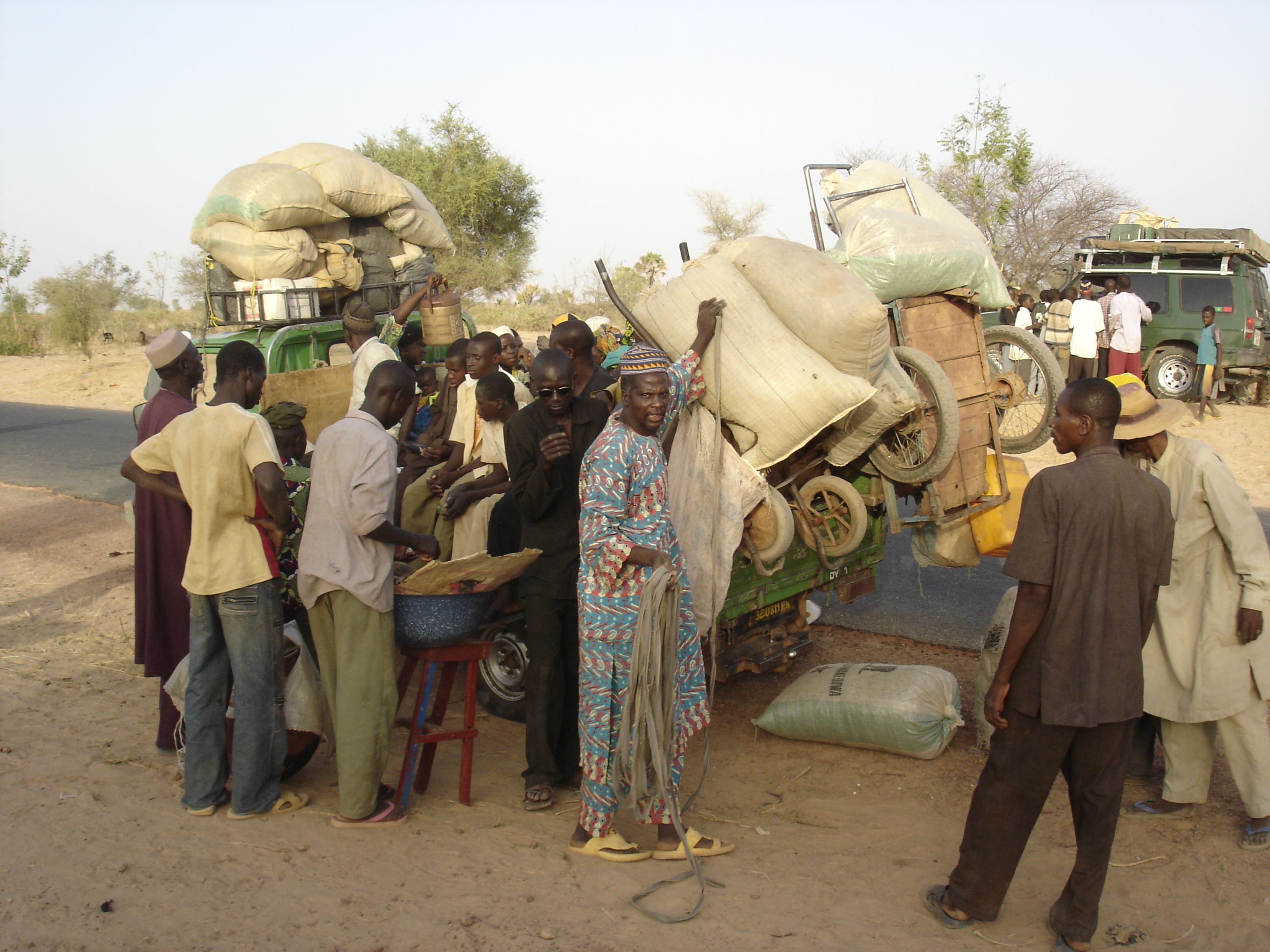

We camped undisturbed in savannah near the border with Nigeria, and continued to the town of Birniri-Konni. This turned out to be a centre for smuggled fuel from Nigeria. We were tempted to fill up at about 50c/litre, but were worried that it could be adulterated so went to the filling station and paid the usual 80c. We stayed that night in Tahoua, at what is listed as the best hotel in town. It looked basic but had the essentials: clean room and cold beer; plus some extras – air conditioning, and pretty good steak and chips. A cold shower would have been nice but the water comes roasting from the roof tank. And the night guard washed the car.

Friday 30 March 2007
Gao, Mali to Niamey, Niger


Coming into Bourem we left the river and travelled over a wide empty plain, then an area of sand with many interwoven tracks. We camped among some low dunes a little south of the town.

There are villages every few miles, so we were not surprised to have some visitors for the evening, and morning. In Gao we pulled in at the Sahara Passion hotel for a shower, lunch, and filled our water tanks. They have a nice shady courtyard full of birds, a relief from the heat, which is in the mid 40s. We registered with the police, as advised by the guidebook and hotel staff. The officer offered to stamp us out of Mali to save time at the border - for a fee - but we declined.


We camped again half way between Gao and the border. It was hard to find a spot remote from the villages that are string along the river. As we cooked dinner, we had two mean arrive separately, one who sat silently and another who chatted. We shared our food, and then when I was on the other side of the vehicle, the friendly one came around and whispered to me that the other man was a bandit, and was going to target us in the night. I said thanks, and we quickly packed up and drove back to the most recent police post. The policeman is exceptionally nice, and told us he does a week’s posting there, night and day, before moving to another town. But there is little traffic, and none at night. In fact the only vehicles we see on the route south are those working on a major upgrade of the road, which will be tarred to the Niger border, and the occasional bus. (This incident was to be the only time I felt at risk during the journey. In the following years, this area became a no-go zone, rife with kidnappings, ambushes and jihadis).

The border formalities were very smooth on both sides. On the Niger side the officer said "Sinn Fein" when he saw the Irish passports. The granaries are different now, built in large beehive shapes with little straw hats over the openings at the top.


The tarred road reappeared, and we pulled in under a tamarind tree for a salad of potato, tomato and sausage with oil and vinegar dressing.

-
 After our breakdown adventure near Timbuktu the rest of the journey to Gao was uneventful. It was a beautiful desert drive, sometimes on the...
 -
Thanks to EU funding, there is now a beautiful road for most of the way from Kayes to Bamako. Only about 80km is piste, and that is being up...
-
This blog is the diary of a journey through the Sahara undertaken February-May 2007. The most recent post is first.